
Market Size for Unicorns: Population vs GDP
How many people a home market needs to grow a unicorn: 33M at high GDP per capita, 48M at mid and 98M at low, and when a startup must go global.
Originally published in MondayVC Newsletter, Edition 16, September 16, 2024, on LinkedIn. Figures are as of 2024.
Key numbers: a home market is big enough to grow a unicorn at a population of about 33 million where buying power is high (GDP per capita over $40K), 48 million where it is mid ($10K–$40K) and 98 million where it is low (under $10K). Below these thresholds, a startup has to think beyond its borders early.
In 2000, I joined DeviantArt, an online community of digital artists worldwide. This exposure showed me how the internet can break down borders and create global communities, solidifying my belief in the power of digital startups to reach beyond local markets.
However, achieving global scale requires more than just a digital presence. For startups targeting local markets or aiming to expand into new regions, understanding diverse macroeconomic landscapes is essential. Today, I’m sharing some insights I’ve gained in this area.
Population Unicorn: Market Size by Buying Power#
Speaking about market size, I compared the number of unicorns to population and GDP.
A big enough local market size for high buying power (GDP/capita) is 33 million population, for mid-power is 48 million, and for low is 98 million people.
For example:
- Low: Vietnam (99M population, $4.4K GDP per capita) or Egypt (113M, $3.5K)
- Mid: South Korea (52M, $33K) or Spain (48M, $33K)
- High: Australia (27M, $65K) or Netherlands (18M, $63K)
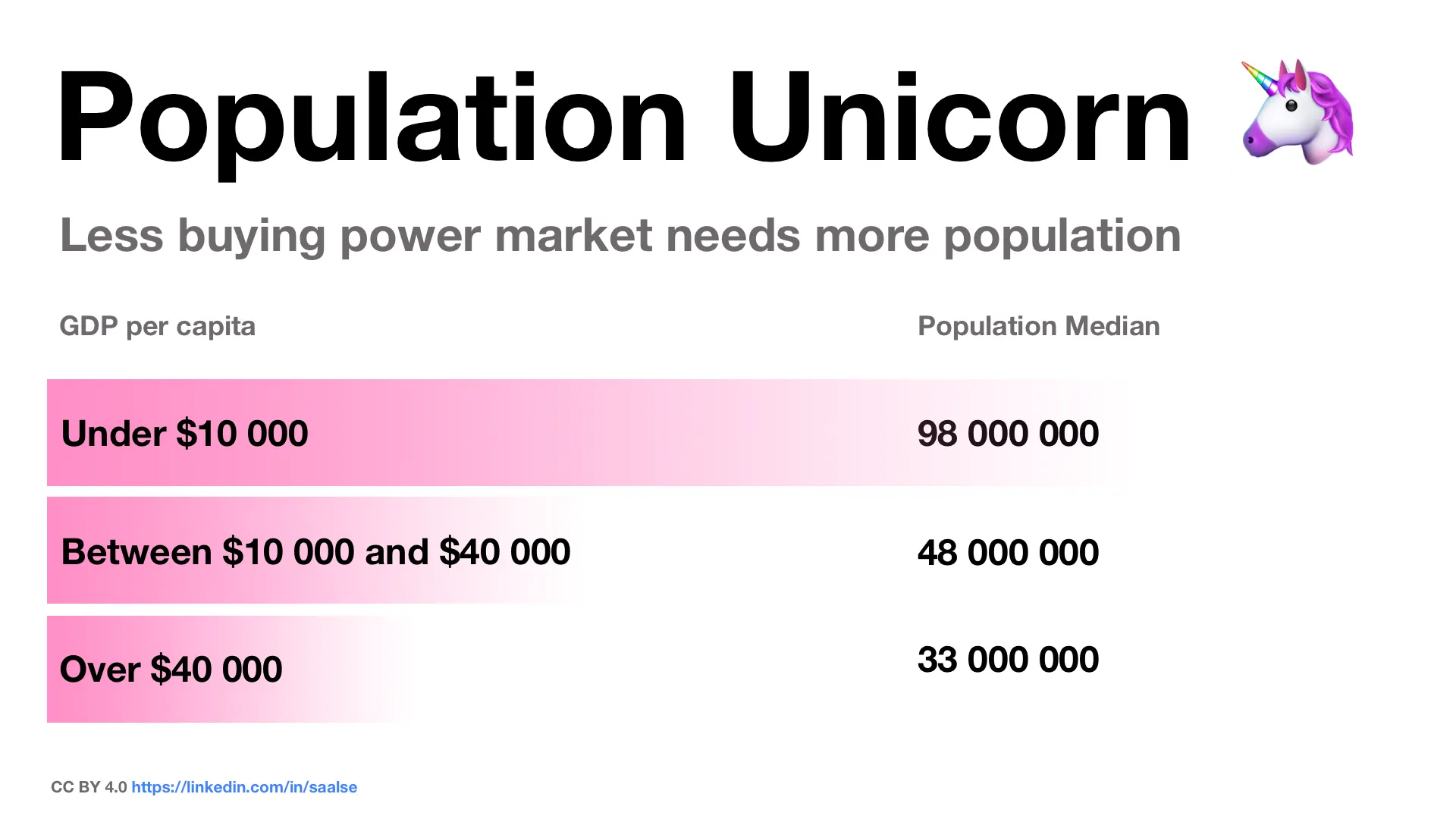
To make this study fairer, I excluded micro-countries, which are usually used as jurisdictions. For a detailed study, read Unicorn Market Size.
Local vs Global#
If a country's population is smaller than these thresholds, reaching a $1B valuation becomes more challenging. It may need stronger market domination, which is often possible through administrative resources in less democratic places, a strategy that’s not sustainable as it relies less on market conditions.
Alternatively, startups must think outside the borders as early as possible. In some cases, the valuation can rise significantly while still being under the unicorn threshold, potentially leading to acquisition by global companies if the country’s politics are not protective.
Startups related to offline processes or local businesses are easier to protect from acquisition or global player market penetration. For example, what can protect a local market from OpenAI? Only firewall games. Does the nation win from such protection? Absolutely not, as it’s impossible to dive deeper into tech fields like AI in isolation.
On the other hand, services like Uber can be blocked at the local regulation level. Without the need for deep tech, local developers can build ride-hailing apps, leaving global players unable to leverage any competitive tech advantages, thus losing the market to local players.
The game changer could be autonomous driving vehicles, but there may be more concern about human drivers losing their jobs than business impacts.
Raising a pre-seed or seed round? I advise early-stage founders on fundraising and the pitch: Startup Advisor.
Previous in MondayVC Newsletter: Edition 15, Fund 1-2-3 Growth Multipliers.
Next in MondayVC Newsletter: Edition 17, Regions of Unicorns.