Capital per GP by Investment Experience: First VC Funds
Median capital raised per GP at 25 US VC firms with a first fund closed in 2023–2024, by prior VC, corporate VC, angel and accelerator experience.
Originally published in MondayVC Newsletter, Edition 10, July 29, 2024, on LinkedIn. Figures are as of 2024.
Key numbers: across 51 GPs of 25 US VC firms that closed their first fund in 2023/2024, the median capital raised per GP was $26M. Partners with prior investment experience raised a median $33M per GP, roughly $3M per year of experience; former GPs of other VCs raised $36M, corporate VC alumni $39M, angel syndicate backgrounds $13M and accelerator leads $8M.
Last week, I explored how the educational backgrounds of VC general partners influence capital raised per GP. Today, I'm delving into how investment experience correlates with this metric.
I examined the LinkedIn profiles of 51 GPs from 25 US-based VC firms that closed their first fund in 2023/2024, looking for any of the following experiences: GP or senior roles in VCs, CVCs, angel syndicates, accelerators, and non-VC, as well as independent angel investments.
The baseline is $26M, the median capital raised per GP.
GPs Without an Investment Track Record#
A third of venture capital firms have one GP who lacks a publicly available investment track record, with a median capital per GP of $15M. If such firms have 3-4 GPs, the median increases to $22M. For firms with just two GPs, the median capital drops to $8M. However, a unique case involved two GPs, both without prior investment records, managing a fund with $18M each.
Obviously, there are no solo-GP firms without previous investing experience.
GPs With VC and Corporate VC Experience#
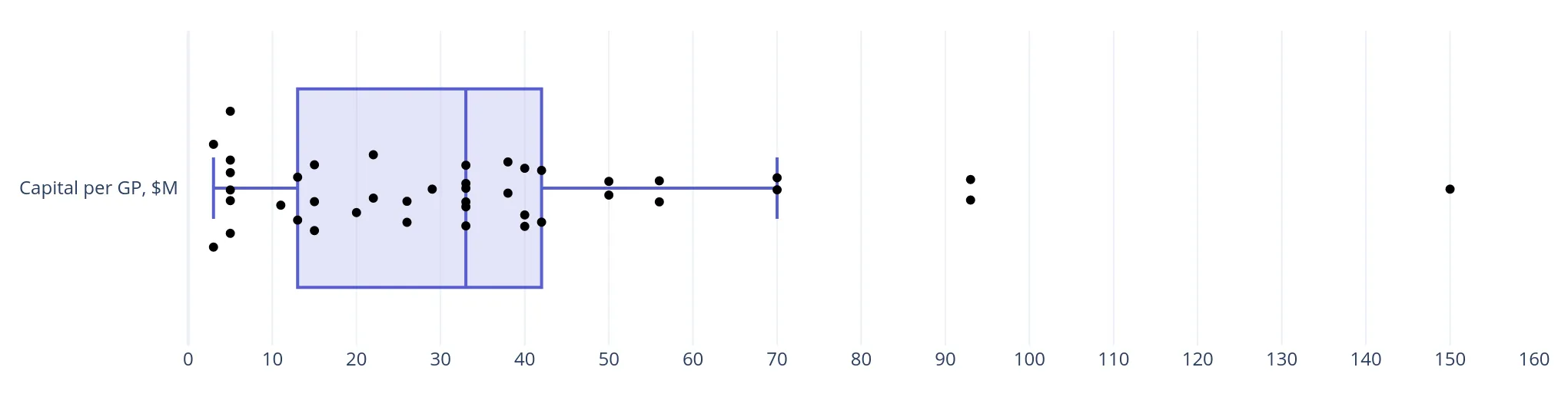
All partners with any prior investment experience show a median capital of $33M per GP.
The median years of accumulated experience is 11, suggesting that each year correlates with the ability to raise approximately $3M. While this is a rough metric, it provides an interesting perspective.
A quarter of partners have experience as GPs in other VC firms. Whether they also held senior positions or not, the median amount raised is $36M, and their career paths span 12-13 years, validating the $3M per year of experience as a baseline.
Partners with Corporate VC (CVC) roles, like Google Ventures, where no fundraising is needed, raise $39M per GP for their own funds, regardless of other experience. This suggests that CVC might boost credibility with LPs or that CVCs become LPs themselves.
Angel Syndicate and Accelerator Experience#
While the sample size is small for strong conclusions, it's interesting to note that GPs who primarily led accelerators show just $8M per GP with 12 years of accumulated experience, translating to $0.7M per year.
Angel syndicate backgrounds perform slightly better than accelerators, with $13M per GP over 10 years, resulting in $1.3M per year.
Individual angel investing also appears relevant, but the data is more complicated as angel investments often mix with firm investments or are less publicly available. Only 20% of GPs have angel investment data on their LinkedIn profiles, showing a median of $15M raised.
Partners Who Invested Together Before#
I examined whether multi-GP firms' partners had shared prior investing experience. 28% of partners previously worked together in their own or third-party funds, angel syndicates, or the Kauffman Fellows program. These partners raised $35M per GP, compared to $20M per GP for those who hadn't invested together before.
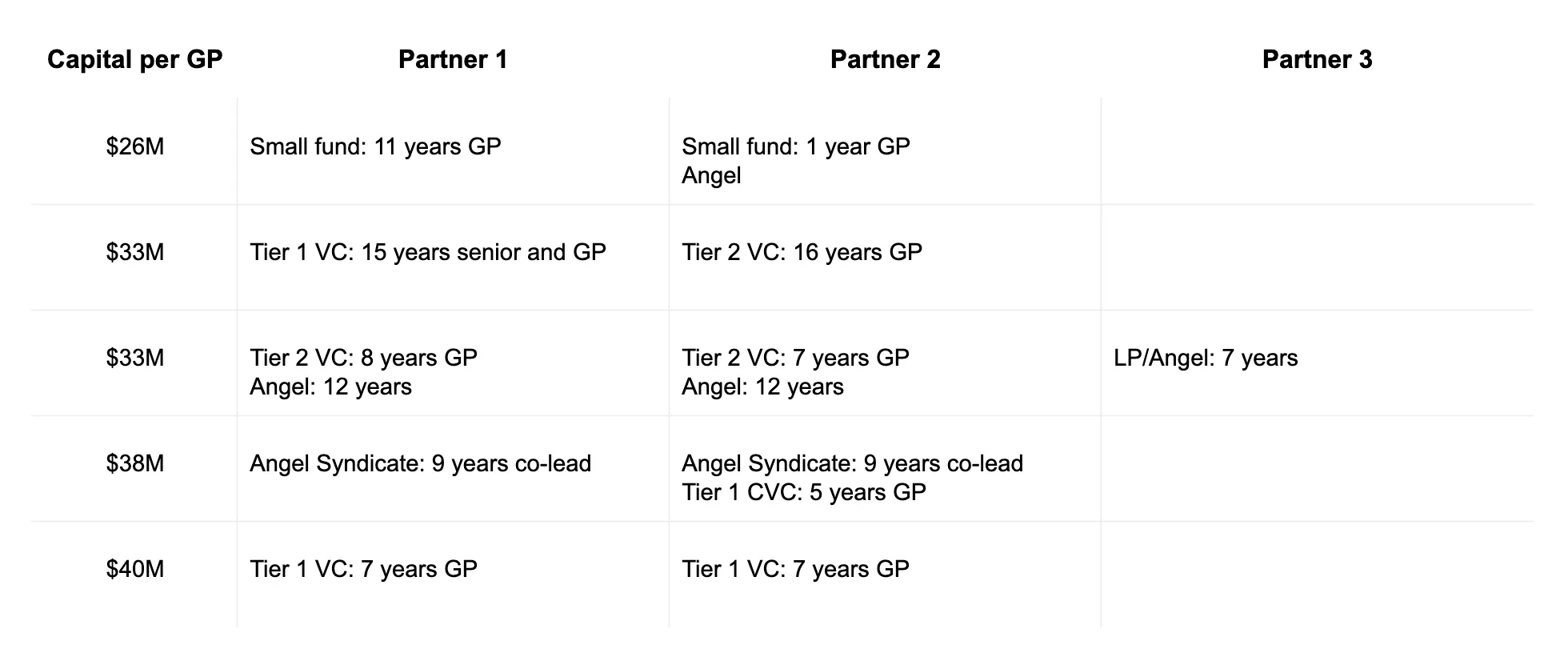
Let's look at a few multi-GP funds raised around $30M per GP to see how partners' investing experience is composed:
Investment Experience and Education#
The last aspect I want to examine is whether there are any interesting correlations with education. Quick facts:
- All GPs with experience in top-tier CVCs as GPs or seniors have education from top 50 QS global universities.
- Only half of GPs with experience in tier 1-2 VCs have education from top 100 QS global universities.
So, for CVCs, top education is a must-have, whereas for top-tier VCs, there are opportunities for everyone, with some priority given to those with top education.
Conclusions#
While years of investing don't necessarily guarantee great achievements and returns, they are useful for identifying trends and making predictions. The industry median for years of experience is quite long, indicating that prolonged success is likely necessary to remain in the field. Additionally, the lifecycle of a fund often aligns with the period during which GPs gain experience before launching their own firms.
Calculating capital per year of experience provides valuable insights for long-term planning. Pairing with experienced investors can also fast track progress in cases of no or low investment traction.
Accelerators and angel syndicates may seem more appealing and accessible for new investors, but data shows a significant decline in capital size associated with these paths. With a $30M target without a fast track, the journey could start with a syndicate for a few years, then transition to a micro VC and steadily advance over the next 8-10 years.
One key aspect not covered in this edition is non-investing experience. Many GPs have backgrounds as founders or C-level executives in big tech or companies backed by VCs with successful exits.
Running a fund or a syndicate? I work with VCs as a venture partner on technical due diligence, deal flow and portfolio support: VC Advisor.
Other studies in the GP background series: Educational Backgrounds and Big Tech and Startup Experience.
Related: LP Fundraising for Emerging VC Funds, my notes on how a new fund finds, qualifies and engages limited partners.
Previous in MondayVC Newsletter: Edition 9, GP Educational Backgrounds.
Next in MondayVC Newsletter: Edition 11, Big Tech and Startup Experience.