Emerging VC GPs: Big Tech and Startup Experience
Capital raised per GP by 51 first-time US VC fund managers, by unicorn, founder exit and big tech background, and the paths to bigger first funds.
Originally published in MondayVC Newsletter, Edition 11, August 5, 2024, on LinkedIn. Figures are as of 2024.
Key numbers: across 51 GPs from 25 US firms that recently closed a first fund, the median capital raised per GP was $26M. GPs with no startup or big tech roles in the last 12 years raised $40M per GP, big tech alumni $33M, and unicorn employees and founders with exits $15M. A year in tech was worth about $1.6M of capital per GP, against $3M for a year in VC.
I analyzed 51 GPs from 25 US-based VC firms who recently closed their first fund, focusing on their tech and startup backgrounds over the past 12 years. Specifically, I examined whether they had been founders or employees in unicorns or startups with exits, or if they held roles in big tech.
This is the last in a series where I explore the correlation between partners' backgrounds and the size of capital they raised. If you missed them, check out the education analysis and VC experience analysis.
The baseline is $26M, the median capital raised per GP.
VC Without Startup or Big Tech Experience#
Surprisingly, the median capital per GP is $40 million for those who haven't worked in startups or big tech in the last 12 years. Among these GPs, 68% have primarily worked in VC over the past decade, often mixed with investment banking. The remaining 32% have backgrounds in government, defense, healthcare, or oil & gas sectors.
Unicorn Experience#
20% of partners have at least 2 years of experience in unicorn startups, typically leaving during late-stage at companies like Dropbox, Slack, Airbnb, or Carta. Did this help them raise capital? Surprisingly not. Their median capital per GP is $15 million—42% below the baseline. However, for those who held C-level or Head positions, the median is $26 million.
Only three GPs were founders of unicorns. Although the sample size is small, the average capital per GP in this group is $90 million.
Exit Experience#
25% of partners have experience as founders with exits or failures, showing a $15 million cap per GP. Interestingly, there's no difference in capital between those with Series A+ exits, seed exits, or failures. All founders, including repeat founders, show similar capital figures, with a median of 4 years spent in the founder role over the last 12 years.
Big Tech Experience#
25% of partners have worked in various roles in big tech for a median of 3 years, with public companies like Google, Facebook, and Twitter. They show $33 million per GP, and those in top positions within big tech show $35 million per GP.
Years in Tech#
I examined when each GP first entered the industry. Some began their careers in technology policy roles or in the tech departments of investment banks, not necessarily as engineers or founders. The median starting year is 2010, equating to 14 years in the sector. Dividing capital per GP by years in the field gives $1.6 million per year of experience. As a reminder from my previous edition, each year in VC adds $3 million to capital, indicating that a year of VC experience is twice as valuable as a year in technology.
I multiplied each GP's years in tech by a $1.6 million baseline to assess what reduces or enhances capital value. By comparing groups with more than 2x diminished value against those with more than 2x increased value, we can observe key differences:
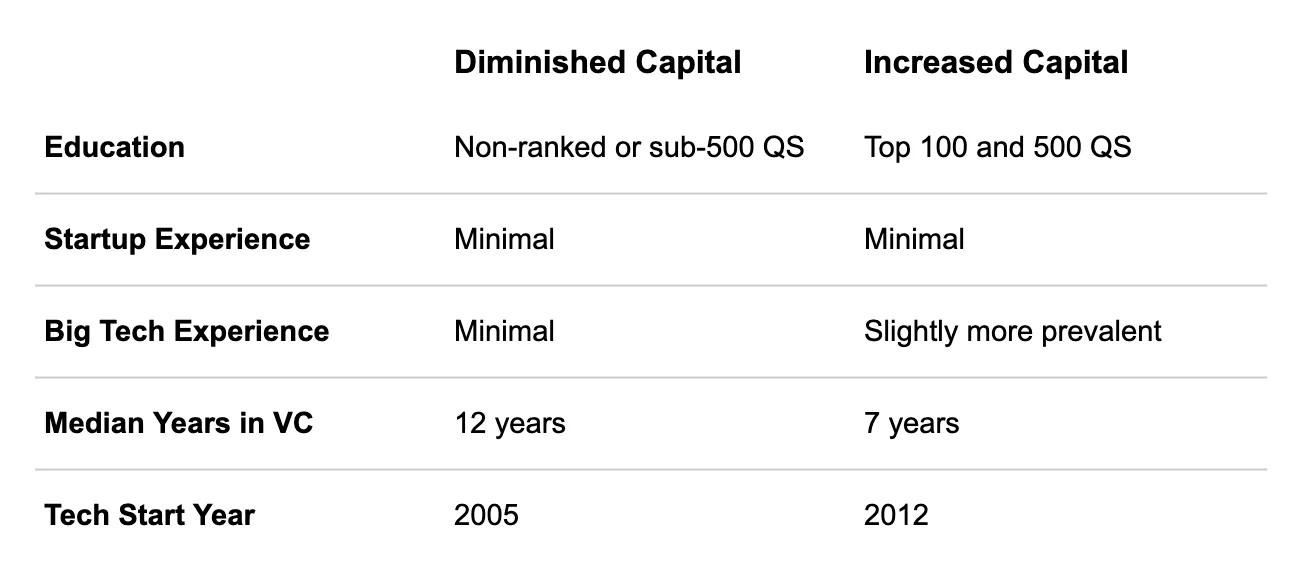
It's surprising to see the reversed impact of years in tech and the starting year. The increased value group entered the tech industry more recently and spent fewer years in VC, yet managed to add more capital value. This suggests that recent experience and a concentrated period in the industry can be more influential than total years spent in tech.
This indicates there is no linear dependency between years in tech and VC experience. It also suggests that those with longer tech experience may already be successful beyond Fund 1, or they might be passive investors as LPs.
Where Partners Find Each Other#
Two-thirds of multi-GP firms have partners with shared experiences through education, work in VC, startups, or big tech. Shared VC experience is slightly more common than shared startup or big tech experience. The median capital per GP is $22 million, indicating that while shared experience is common, it is not required to excel in fundraising.
A third of multi-GP firms have partners with shared working experience unrelated to investing, such as being former employees or co-founders of a startup. However, this combination shows a 23% decline in median capital, with $20 million per GP.
Mixed Experience#
Let's examine the sweet spot of 14 GPs who raised between $26 million to $40 million each. This group includes three solo GPs, four double GP firms, and one triple GP firm. They have a median of 10 years in VC and typically boast two achievements: working in unicorns, big tech, or being exited founders. Notably, 57% have top 100 university education, 57% have big tech experience, 36% have unicorn experience, and 14% have founder exit experience.
Another perspective is 28% of GPs with 0 to 2 years of VC experience have $22 million per GP, which is impressive for entry-level. What do they offer instead of investing traction? Half have top 100 education, and 86% have worked in or founded unicorns, exited as founders, or worked in big tech. Only two GPs lack significant career achievements in tech/VC, but both are GPs in multi-GP firms.
With low or no VC experience and without notable achievements, there is still a chance for a good raise with experienced partners.
Final Thoughts#
Analyzing education, VC experience, and tech business experience reveals multiple paths to fundraising success. Obtaining an MBA from a top university provides a strong boost in any scenario. Besides that, aspiring VCs can pursue one of three main paths: spending four years as a startup founder, three years in a big tech corporation, or two years in a unicorn startup. Within these paths, it's important to engage in angel investing as early as possible to build years of traction. Ideally, a successful path will include two of these three experiences within the last 12 years. The best route is to complete the journey in a corporate VC or top-tier VC for 2-3 years. Alternatively, entering a top-tier VC from a mid-career position and spending around seven years there is another viable option.
The final piece yet to be covered is the performance of investments these partners achieved before launching new VC firms, whether as angels or GPs in other funds. Though data is limited, the assumption is that a strong deal flow and high returns can outweigh any other factor.
Running a fund or a syndicate? I work with VCs as a venture partner on technical due diligence, deal flow and portfolio support: VC Advisor.
Related: LP Fundraising for Emerging VC Funds, my notes on how a new fund finds, qualifies and engages limited partners.
Previous in MondayVC Newsletter: Edition 10, Investment Experience.
Next in MondayVC Newsletter: Edition 12, Angel Rounds.