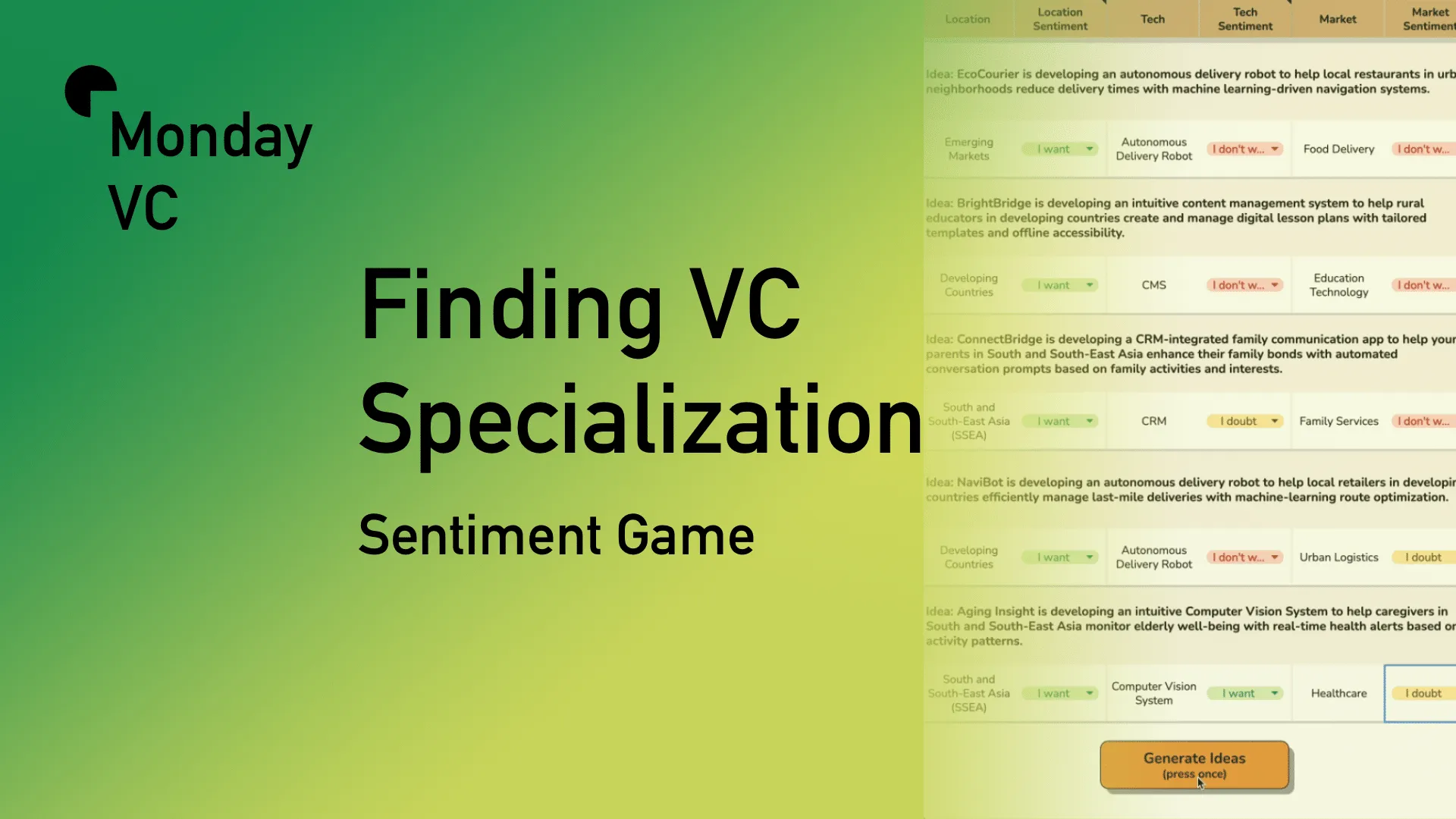
VC Specialization: Specialist vs Generalist Funds
Why specialist emerging VC funds outperform generalists by 25%, how I looked for my focus, and a Google Sheet game that maps startup preferences.
Originally published in MondayVC Newsletter, Edition 14, August 28, 2024, on LinkedIn. Figures are as of 2024.
In short: specialists outperform generalists by 25% in emerging VC returns, so I looked for my own specialization by tracking my feelings about startup locations, technologies and markets, with a VC Sentiment Game: a Google Sheet that generates startup ideas with the OpenAI API.
Specialists outperform generalists by 25% in emerging VC returns. That's enough for me to follow this law when outlining my investment strategy. However, it's the most challenging decision, given my two decades of experience as a startup generalist.
I also see how people struggle to focus on even one problem-solution when starting a new venture. So, if you don't tend to be a generalist or don't have years of experience in the specific industry you love to invest in, read my approach next.
How I Looked for a Specialization#
Industry, technology, business model, founder types, or geo can be the core focus around which a specialist VC builds knowledge and network. One of the operational benefits is cost reduction in screening and due diligence of startups, with quick access to market metrics, key players, tech feasibility, and experts. Learn more about the link between due diligence math and unicorn hunting.
Initially, I was thinking of focusing on computer vision AI technology, where I have a few years of startup-building experience, which has always excited me. It's a trick of keeping myself a generalist across industries while being a specialist in specific tech. After a while, I found it too narrow, affecting my thesis-market fit, and started looking broader.
Then I noticed strong feelings about whether I wanted to dive deep into random inbound deals or not. The problem was that a few startups I was excited about and assessed this year for potential angel investment were quite different from each other, putting me back on the generalist track, which I want to avoid.
A week ago in a Jungian analysis session, I was surprised to learn that feelings are responsible for decision-making assessment, while I had supposed it was thinking, which sometimes makes me mad when weighing complex decisions. So I increased my sensitivity towards industries and technologies and started looking for similarities in early-stage startups I was excited about, which led me to some discoveries.
Moreover, I created a VC Sentiment Game based on a startup idea generator. It identifies personal favorites and outsiders in terms of startup locations, technologies, and markets.
The VC Sentiment Game#
It's a Google Sheet that generates 5 startup ideas. For each startup, you have to express simple feelings about location, tech, and market: I don't want, I doubt, or I want. Then it generates 5 more until you gather enough insights.
Each location, tech, and market has a default weight of 1. Don't want decreases the weight by 10%, doubt keeps it the same, and want increases it by 10%. Locations and techs with a weight below 0.6 or above 1.6 are excluded from further ideas.
There are predefined lists of technologies, locations, and 600 topics based on Amazon's books and product categories for idea insights. The generator uses a modified version of the Founder Institute's One-Sentence Pitch Format and the OpenAI API with the GPT-4o model. The same API is used to identify markets based on the ideas.
Running a fund or a syndicate? I work with VCs as a venture partner on technical due diligence, deal flow and portfolio support: VC Advisor.
Previous in MondayVC Newsletter: Edition 13, Asia VC Funding Benchmarks.
Next in MondayVC Newsletter: Edition 15, Fund 1-2-3 Growth Multipliers.