
VC Team Size and Composition: Fund I, II and III
Median team size, capital per GP and yearly investments at 30 emerging US VC firms on Fund I, II or III, and which paid and non-paid roles they hold.
Originally published in MondayVC Newsletter, Edition 7, May 27, 2024, on LinkedIn. Updated October 31, 2026. Figures are as of 2024.
Key numbers: at 30 emerging US VC firms, ten each on Fund I, II and III, the median paid team stayed at 3–5 people with 2 GPs while median total capital grew from $10M to $44M and $156M. The firms made about 8 investments a year: about 5 per GP and 2 per paid team member.
The key asset in venture capital is people.
It's important to understand who is needed in the team, the wage fund, and the source of cash for that. This will be the biggest operational expense for a VC firm, which is essential to consider before launching a fund.
I analyzed the team structures of 30 VCs based in the US, with ten in each group: those that closed Fund I, Fund II, or Fund III in the last 3 years, meaning they are still in the active investing period.
I tried to take firms with capital aligned with VC Lab’s Management Fee Model: Fund 1 — $5M, Fund 2 — $20M, Fund 3 — $50M, but it was quite challenging in the US. Adeo Ressi’s model seems to be based on global median fund sizes and doesn't match the typical fund size there or reflect the industry’s shift towards more accessible, smaller initial funds.
VC Team Size#
I was surprised to find that regardless of firm maturity and total capital only a few people are needed in the team. I tried different approaches with median values:
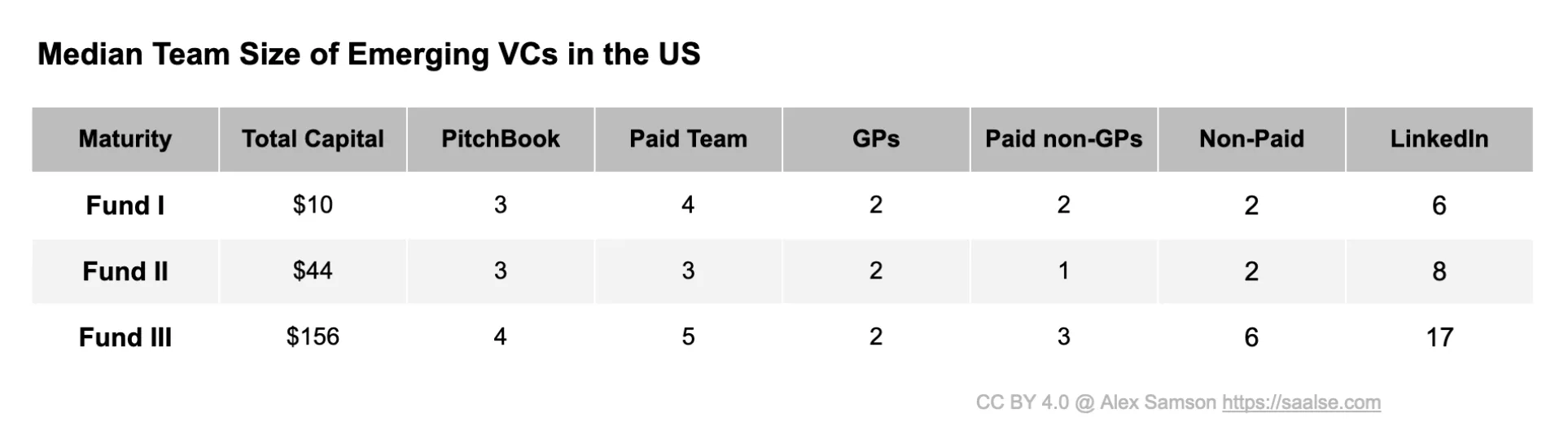
- PitchBook: Excludes VPs, advisors, and other unpaid roles; data may be outdated.
- Paid Team: Derived from official websites and LinkedIn profiles, excluding typical unpaid roles.
- GPs: Includes founding, managing, and general partners. Other partners are categorized as paid non-GP roles unless specified as venture partners.
- Paid Non-GP Roles: Encompasses roles in operations, finance, principals, associates, analysts, interns, assistants, communications, staffing, EIRs, and domain experts in areas like growth and tech.
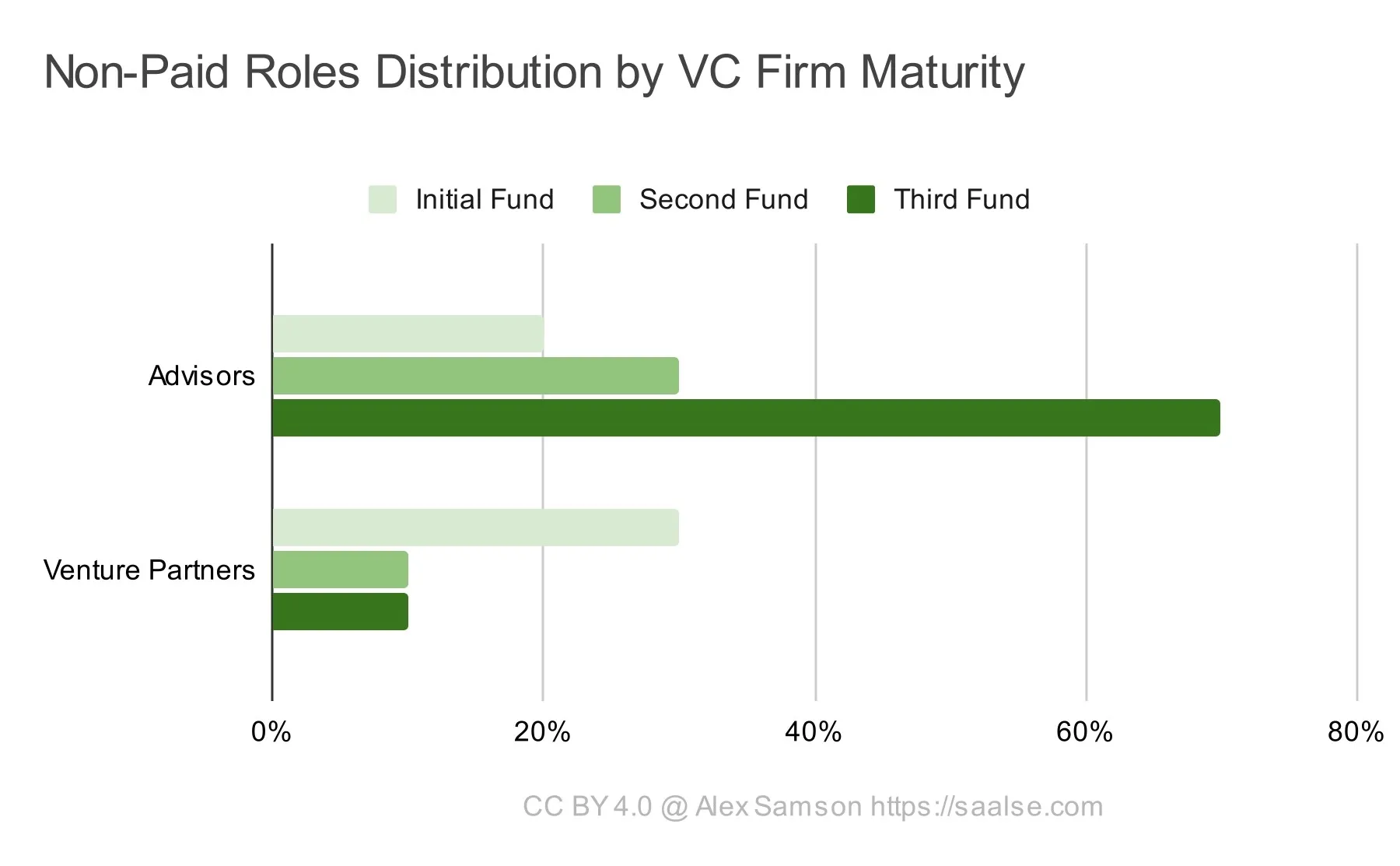
- Non-Paid Roles: Consists of venture partners, advisors, and public LPs.
- LinkedIn: Provides the most accurate depiction of paid roles and includes additional unpaid roles such as some public LPs, VPs, and advisors. Also includes fake profiles.
VC Team Capital#
Conversion of GPs into Capital:
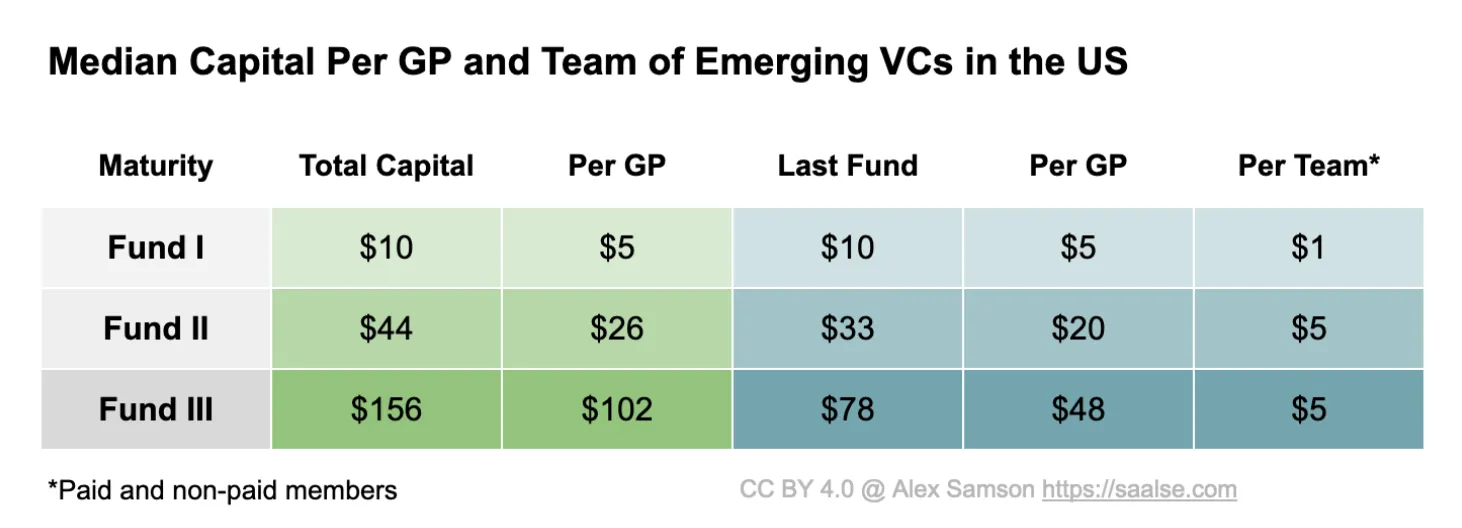
Despite similar headcounts across Funds I to III, capital per GP significantly increases with each subsequent fund, indicating that capital growth is more linked to traction and thesis than to core team expansion.
However, when analyzing the last fund size divided by the LinkedIn team, the capital per member remains consistent between Funds II and III, despite a twofold increase in capital. This pattern, if not a statistical anomaly from a small sample, suggests that as VC operations progress, the network of LPs, VPs, and advisors expands, organically boosting capital raising efforts.
VC Team Investments#
Exploring Team Size and Investment Activity:
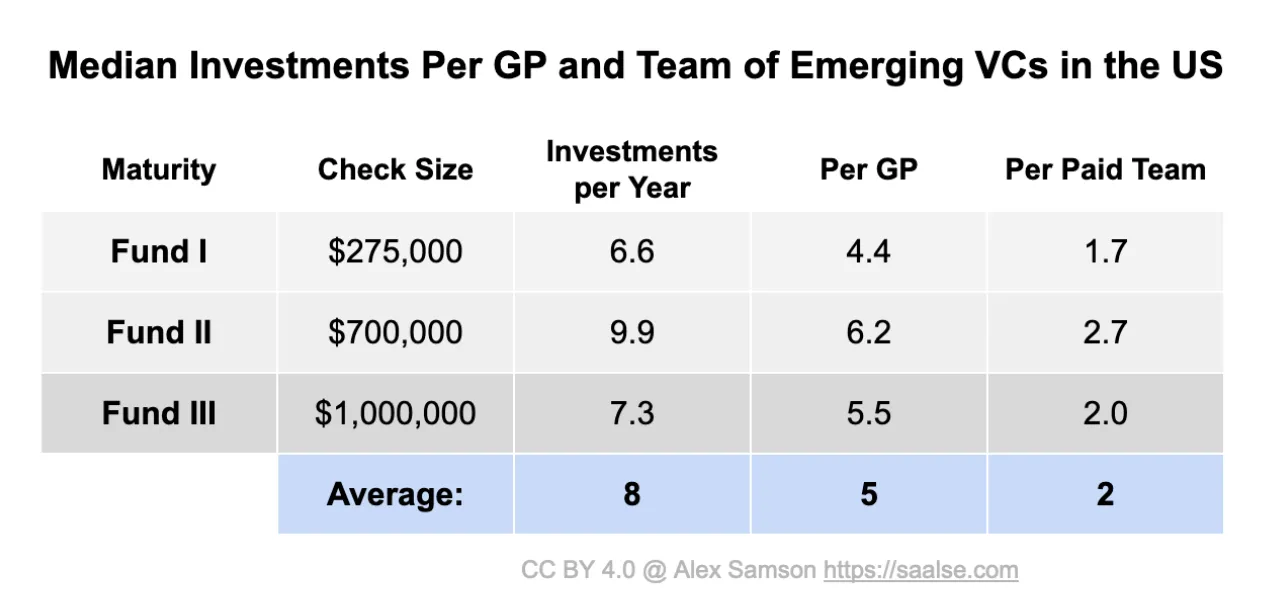
Investments were normalized by dividing total investments by the years since the firm's inception, yielding an average of 8 investments per year across varying stages of firm maturity.
Despite potential inaccuracies due to the small sample size, fundraising periods, and market fluctuations, the data suggest that as firms mature, the increase in capital is driven more by larger check sizes than by more deals. Consequently, there's no need to expand the team, allowing firms to maintain lower operational costs while potentially increasing earnings from management fees.
The investment rate remains consistent across different funds and team sizes, averaging about 5 investments per GP annually and about 2 per paid team member, aligning with findings from my deal flow and due diligence math analysis.
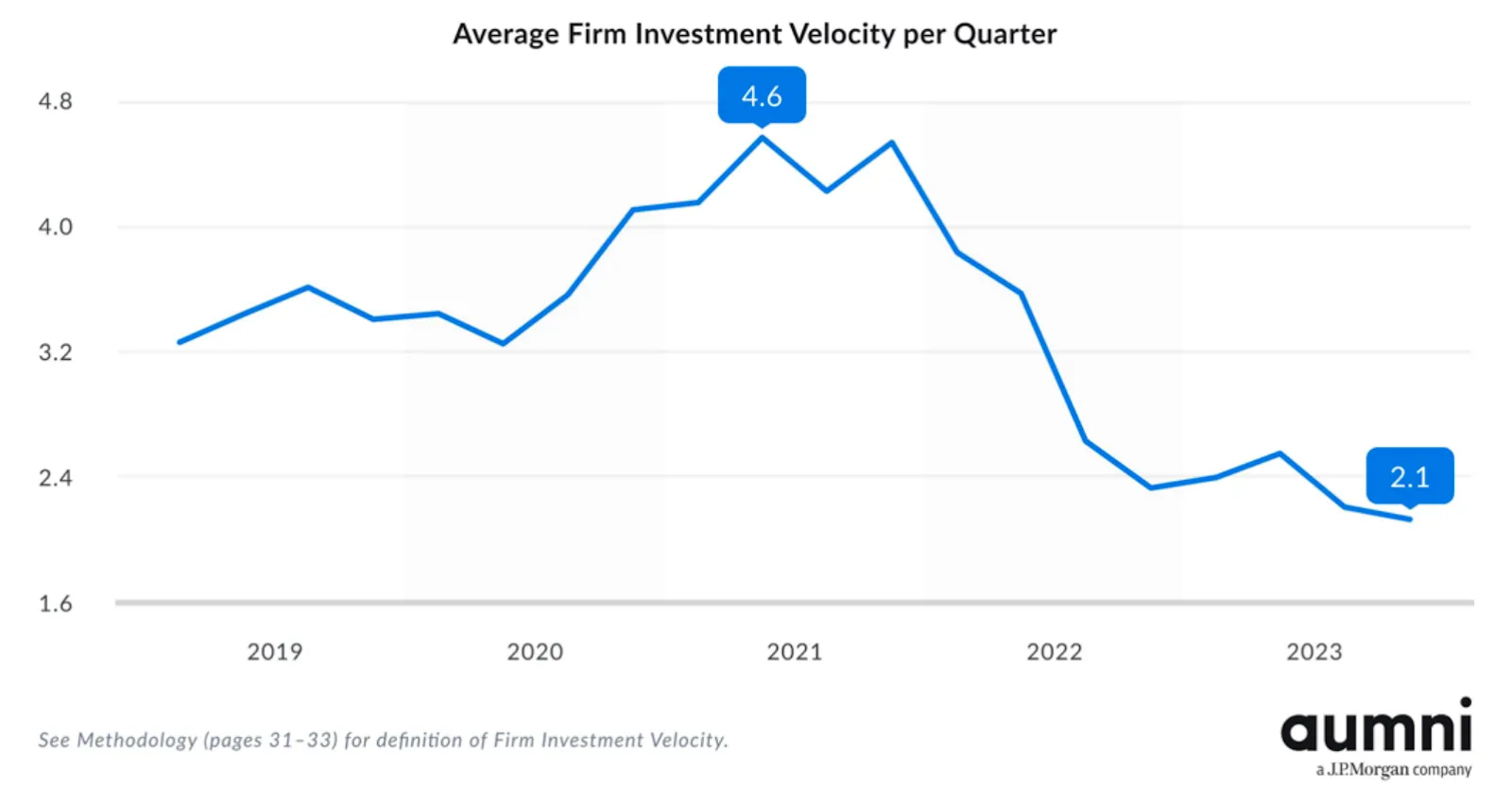
Additionally, this investment rate is corroborated by the average investment velocity data from Aumni:
VC Team Composition#
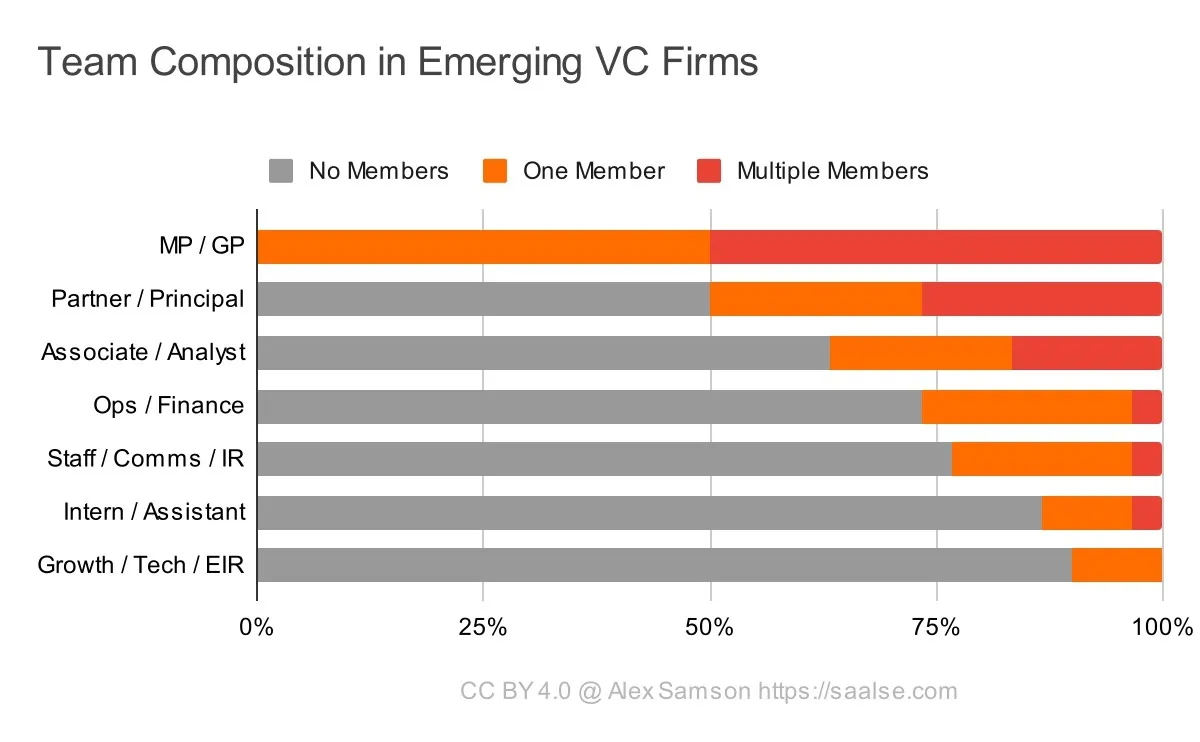
The number of paid team members, including GPs, remains stable as firms progress from Fund I to Fund III. Here’s an overview of the paid roles across 30 firms, analyzed without regard to firm maturity:
As a VC firm matures, the number of advisors typically increases while venture partners decrease. This trend might reflect an initial need for venture partners to support new GPs, shifting to a preference for advisors as the firm confirms its thesis and secures more capital. Additionally, the increase in LPs willing to serve as advisors could coincide with the growing total number of LPs:
Conclusions#
I anticipated a smaller team size for the initial fund, but it was surprising to discover that even with $156M in total capital by Fund III ($78M in Fund III itself), the same team size remained effective. This analysis clarifies how to forecast team-related expenses over a decade using my VC Economics Modeling Tool.
I reflect on my experience managing a team of 50 and ask myself: How is it possible to run a business with such a small team?
Limiting salary expenses is necessary because they are covered by the management fee, which provides a relatively small operations budget during the emerging phase of a VC.
There can be practices to outsource as much as possible, trying to charge these expenses to the fund or portfolio companies:
- Outsourcing operations and charging these costs to the fund for needs like deal due diligence and legal support, rather than through management fees.
- Shifting certain expenses to portfolio companies, such as board meetings.
- Occupying paid board positions, although it’s akin to double dipping.
I’ll explore this topic in further editions.
Previous in MondayVC Newsletter: Edition 6, Fair Startup Valuations.
Next in MondayVC Newsletter: Edition 8, VC Management Fee Expenses.