Angel Rounds: Timing, Check Size and Equity Share
When angels invest from idea to seed, angel check size tiers from $10 to $100K+, and the equity share angel and pre-seed investors take, with Carta data.
Originally published in MondayVC Newsletter, Edition 12, August 12, 2024, on LinkedIn. Figures are as of 2024.
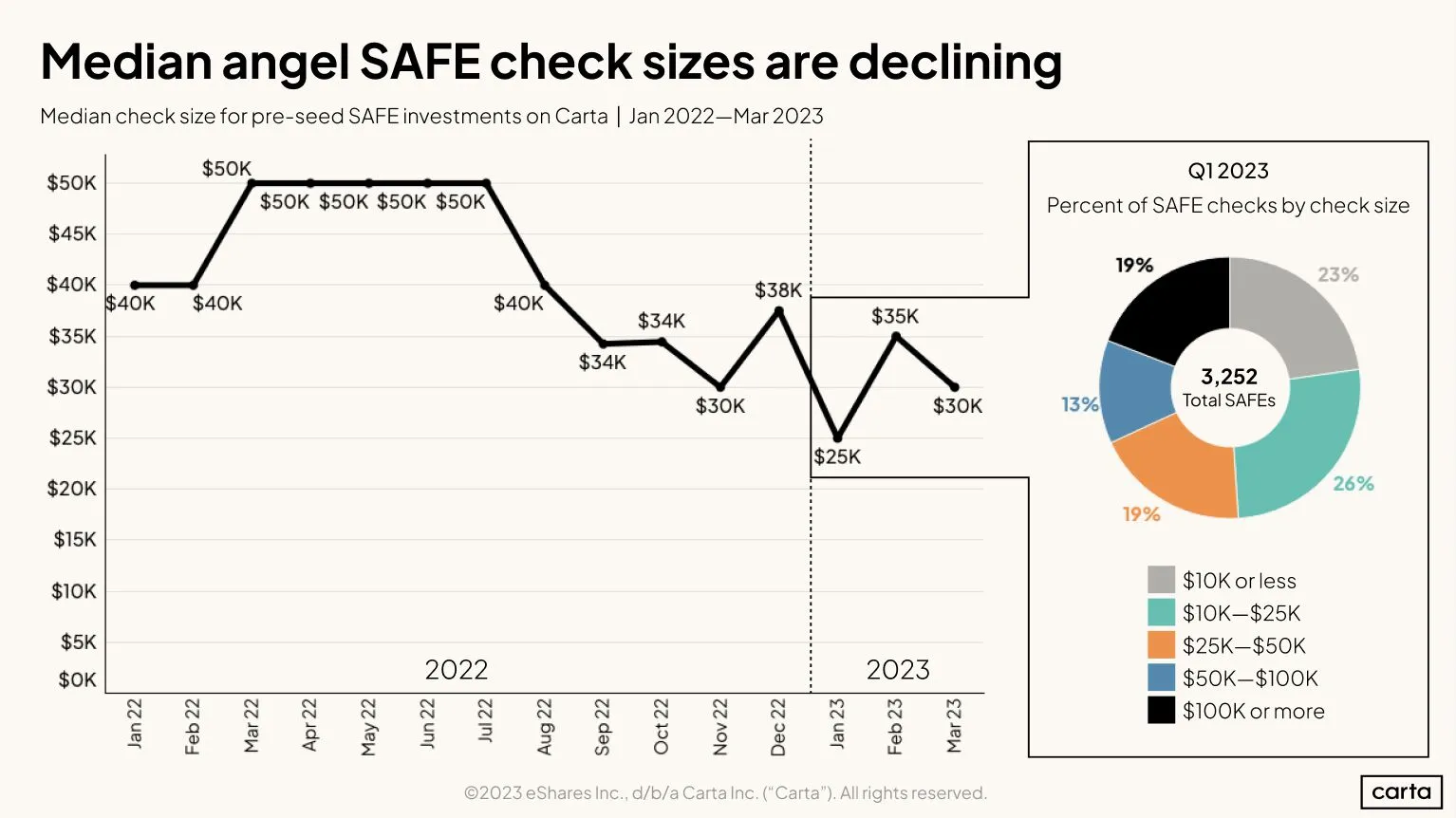
Key numbers: angel checks range from $10 on investment platforms to $100,000+ for super angels, with a market median angel check of $30K (Carta). Pre-seed investors in the US took 9% to 17% of the startup in H1 2024 (median 13%); seed and Series A investors took about 20%, and small pre-seed rounds gave as little as 4%.
What’s the difference between angel and pre-seed rounds? Whether you’re investing or raising funds, let's explore when to invest, how much to give, and what to take.
Angels operate before or instead of pre-seed or bridge between early stage rounds. They also serve as follow-on investors in any non-angel round.
And this is the only opportunity to build investment traction before launching a VC firm, particularly if primary career is outside venture investing.
When Angels Invest: Idea, Pre-Seed and Seed#
Idea Stage#
Startup begins from the idea stage with idea validation, market research, and drafting a business model. This stage is no- or self-funded. In rare cases, there can be a founding angel, which helps cover preliminary research costs.
Pre-Seed Stage#
A startup enters the pre-seed stage where validating product-market fit (PMF) is the key goal. Pre-seed has three phases:
- Pre-product, pre-revenue: The entry phase is to build a PoC or MVP.
- Post-product, pre-revenue: The middle phase is to go to market, gaining validation like soft commitments, community approvals, pilots, or first revenue.
- Post-product, post-revenue (not always): The exit phase is finding PMF validated by rapid growth of business metrics, which is much better if monthly recurring revenue is $20K+.
Independent angels can support any phase of pre-seed without a round. A structured angel round is likely to be in the post-product middle phase and beyond if there is no VC firm or strong pre-seed accelerator involved.
Seed Stage#
In the seed stage, startups aim to scale rapidly within unit economics to surpass $1M ARR. A seed round led by a VC firm is more likely to happen. In rare cases, it can be led by an angel syndicate but is still called a seed round instead of an angel round.
Angel Check Size by Tier#
Angel investing is available to everyone, and traction isn't about how much is invested but about the strategy and returns.
The micro tier starts at $10 per deal using investment platforms available globally, such as Republic. Such nano-investing is made possible by full process automation without providing any personal experience for the investor.
The low tier starts from $1,000, where participating in angel syndicates (aka groups, networks) becomes available, for example, AngelList. More private groups require a minimum of a $5,000 check, which offers a personal experience connecting with a like-minded community and partial access to founders.
The middle tier starts from $10,000, where an angel can lead a syndicated deal or act as a direct investor, considering the market median check of $30K based on a year-old Carta report.
The high tier starts at $100,000, usually by strong leaders in the startup ecosystem or professional investors, who are also called super angels.
Angel Capital Allocation Rule#
Angel investing is highly risky. The standard allocation formula is: annual income × 20% savings × 5% to 50% (from conservative to aggressive). With a 90% failure rate among startups, spreading investments across at least 10 deals is recommended.
For instance, with an annual income of $250,000, the calculation is $250,000 × 20% × 10% / 10 = $500 per deal annually, suitable for investment platforms only. Alternatively, the strategy can extend over 2–3 years, given limited access to angel syndicates with $1–2K deals. A more aggressive approach might allocate over 20% from savings, ideal for those experienced in the tech industry, with $2–5K per deal.
Direct angel participation beyond $10K per deal typically requires high-liquidity events, such as a substantial annual bonus, M&A, or at least $1 million in wealth.
Angel and Pre-Seed Equity Share#
Pre-Seed Data#
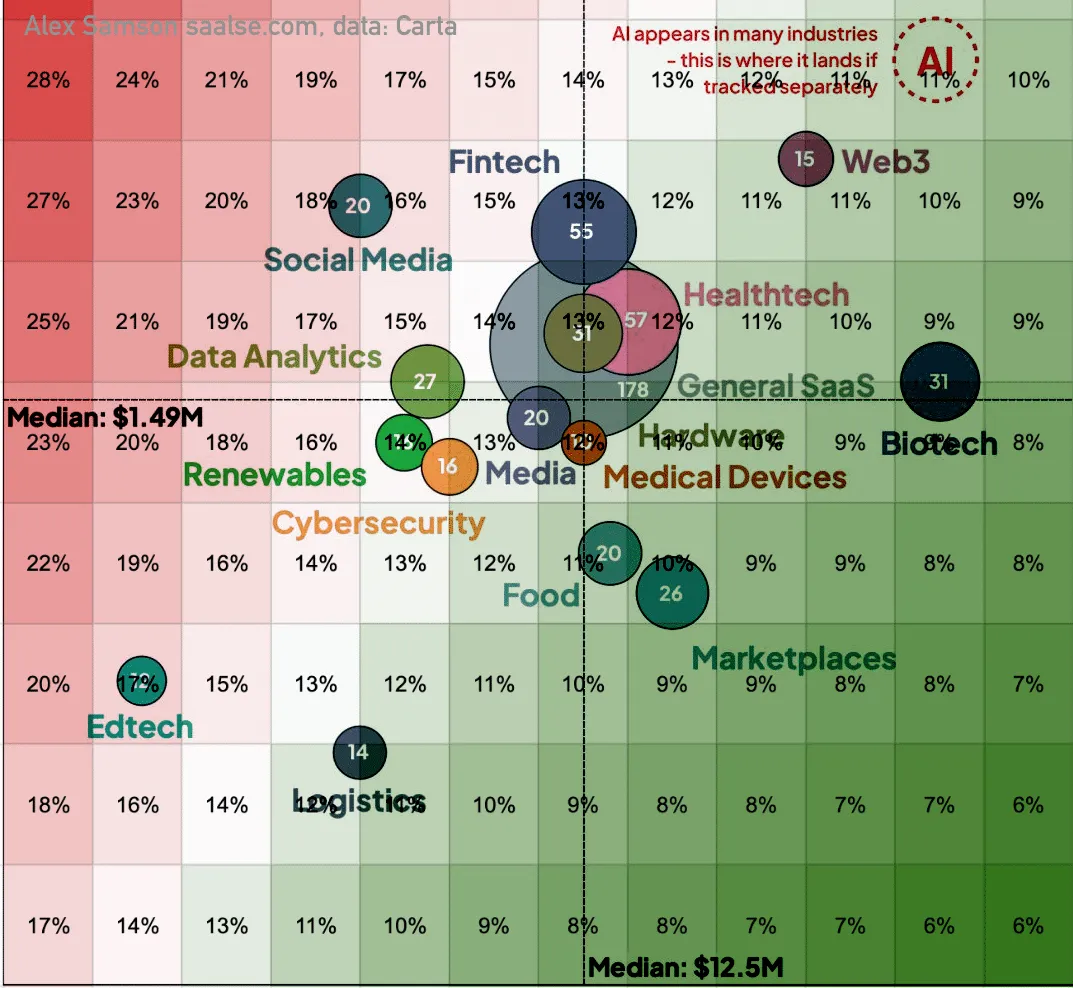
Carta recently posted a pre-seed benchmark per sector with a median cash raised ($1.49M) on a median valuation ($12.5M) in H1 2024 in the US. This results in an equity share (dilution) for pre-seed investors between 9% and 17%, with a median of 13%. See my overlay and the original chart available in Peter Walker's LinkedIn post.
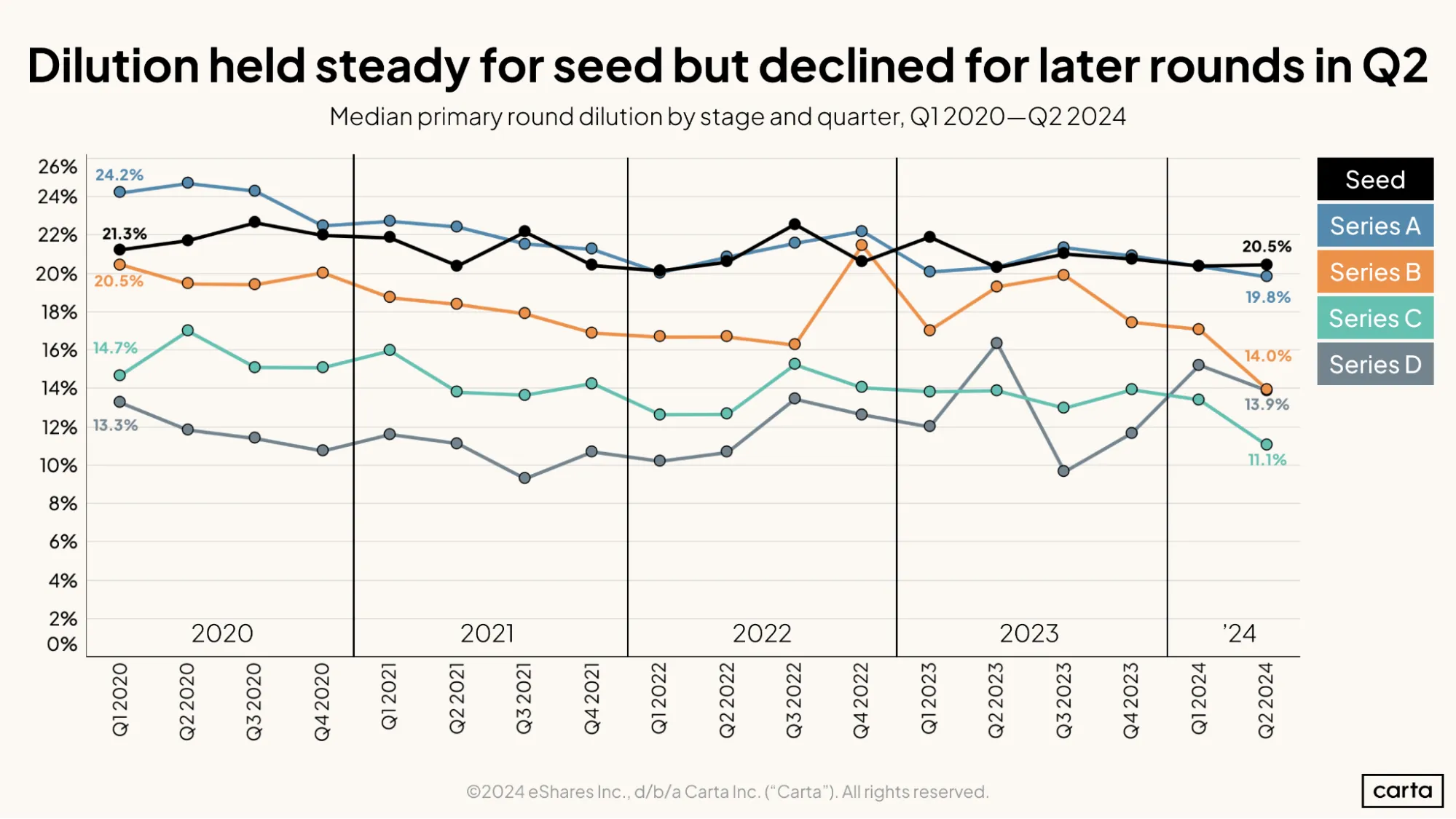
Another Carta report, State of Private Markets: Q2 2024, indicates investors take 20% of the startup in the following Seed and Series A rounds, even though they are less risky than pre-seed:
Finally, the Carta State of Pre-Seed: Q1 2024 report shows that investors can get as little as 4% in small pre-seed rounds:
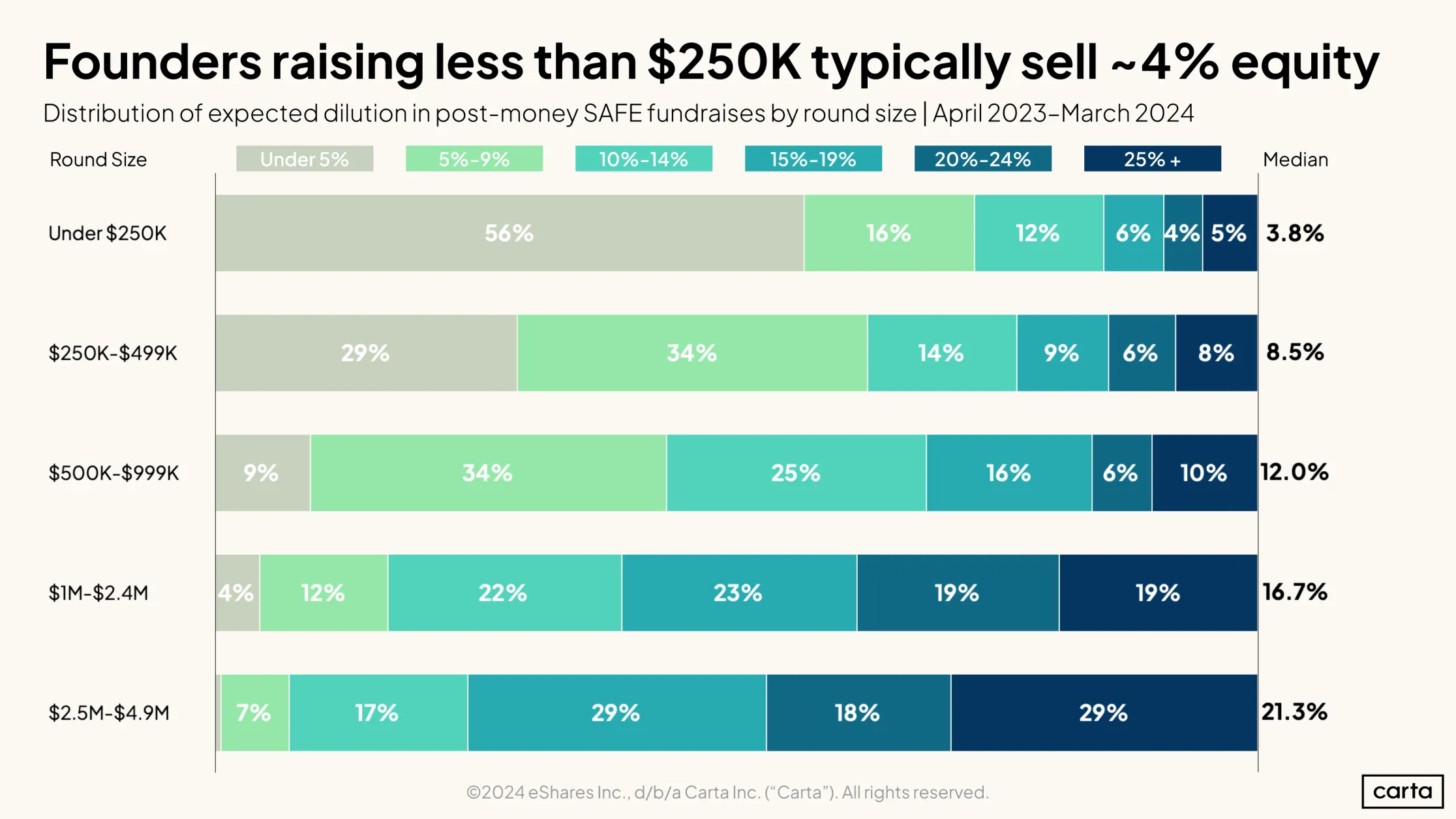
The average cost to build and launch a tech startup in the U.S., including initial customer acquisition to reach $1M ARR and high-risk capital, is about $5 million. This is relatively modest when spread over a median 36-month journey from idea to Series A.
Fortunately, there are ways to validate ideas and markets before spending millions during smaller angel or pre-seed rounds. However, the target cost of a startup remains unchanged, which is why business valuations start high even at these risky early stages. Given the smaller round size, investors receive smaller equity.
Angel Data#
I haven’t found datasets for angel valuations, so let's use Y Combinator’s $1.8M valuation, where they invest $125,000 for 7% (since 2022 YC adds $375,000 on an uncapped SAFE, $500,000 in total). YC provides substantial value with their credibility and network, the smart component of their cash investment. This component can easily be valued at an additional $250,000 or more, making a more realistic valuation benchmark for angels closer to $5 million.
Do Angels Need a Round?#
An angel round is when multiple angels invest together, independently or through a syndicate, to reach funding goals without involving VC funds or accelerators. It's harder to organize for investors and to raise for startups. However, it secures each angel's interest through collective assessment, and startups receive enough financing to focus on reaching their goals plus collective support.
Non-round investing occurs on a less predictable, rolling basis, with angels supporting founders at the idea or pre-seed stage to help achieve specific goals while bootstrapping or preparing for a round. It's much easier at the idea stage or MVP-building phase if founders have a small track record, but it could lead to cash gaps, and ongoing fundraising will distract from reaching goals. It's more suitable for investors from the inner circle of friends and family or for high-tier angels investing in serial founders.
Raising a pre-seed or seed round? I advise early-stage founders on fundraising and the pitch: Startup Advisor.
Related: Angels and Syndicates in VC, Edition 3, on the share of angels and syndicates among VC investors and deals.
Previous in MondayVC Newsletter: Edition 11, Big Tech and Startup Experience.
Next in MondayVC Newsletter: Edition 13, Asia VC Funding Benchmarks.